
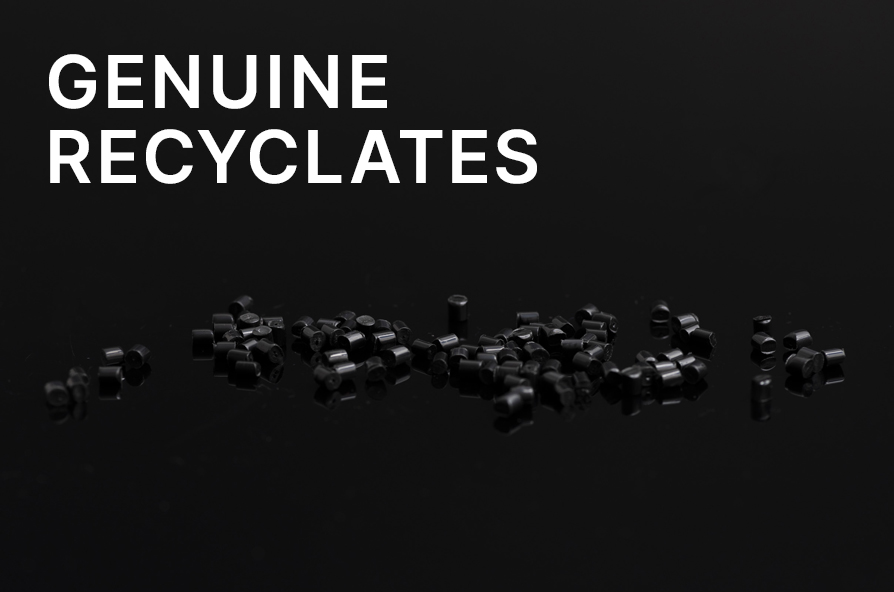
Without waste there is no recyclate! For: In 2020, German legislation defined the term recyclate as “secondary raw materials obtained through the recovery of waste or produced during the disposal of waste, and suitable for the manufacture of products.” In this sense, plastic waste arises on the one hand, for example, from disposed packaging film, cups and containers – the so-called post-consumer waste. On the other hand, industrial processes also produce plastic waste – post-industrial waste.
But when is a plastic actually waste in the legal sense? That’s where the judiciary comes in: Plastic is waste when its owner disposes of it, wants to dispose of it or has to dispose of it. The so-called “will to dispose” is the key concept here. Only if this is the case can the waste become recycled plastic again.
This is where ENNEATECH comes in. The company buys leftovers from fibre and yarn production, filaments, ropes and belts that fibre manufacturers want to dispose of. Instead of ending up in landfills or incinerators, the fibres are sent to Enneatech. This makes the company not only a plastics processor, but also a specialist waste management company. Here, the fibre waste is transformed into high-quality PA recyclates and compounds. For this purpose, the fibre residues are first analysed, shredded and regranulated in several extrusion lines. This means they go through a recycling process in plants approved under the Federal Immission Control Act (BImSchG). According to the definition, these are facilities for a “recovery operation by which waste is processed into products, materials or substances and subsequently used for its original purpose or other purposes.” In plain language, this means: ENNEATECH’s PA recyclates and compounds are used by plastics processors to produce components for the automotive, construction and other industries.
The unbeatable advantage of genuine recyclates is their CO2 footprint. The polyamide as a raw material is already available thanks to the fibre residues, and no longer has to be produced from fossil raw materials in an energy-intensive way. In fact, the CO2 footprint of ENNEATECH recyclates is already 96 per cent better than that for virgin material. The CO2 footprint can be precisely quantified for each customer’s product – a great advantage for all those on the path to climate neutrality.
Waste or by-product?
Waste is not to be confused with a by-product. According to the legislator, a by-product is produced in a manufacturing process whose main purpose is not directed towards the production of this (by-)product. This includes, for example, the edge trim in a film extrusion. The purpose of extrusion is to produce the film, not the trim. The latter is collected by the feeders, ground up, and the by-product is fed back to the extruder. According to Section 4 (1) of the Closed Substance Cycle Waste Management Act, it is a by-product under the following conditions:
- The by-product is reused, and
- no further pre-treatment beyond a normal industrial process is required for this.
- The material is produced as an integral part of a manufacturing process.
- Further use is lawful.
A more complex example of a by-product from the “Recycled Plastics in Production” handout from GKV, BDE and BVSE
When manufacturing a component from plastic, direct use of the production residue in one and the same process is not possible. The residue must first be ground or crushed by the company itself or a third party before it can be processed again in the same plant where the main product was produced. The grinding or crushing of the material is a “normal industrial process”, even if it is done by a third party. If the other requirements of Section 4 of the Closed Substance Cycle Waste Management Act also apply, it is a by-product and not waste, and thus does not constitute the use of recyclate.

